Read this guide as text
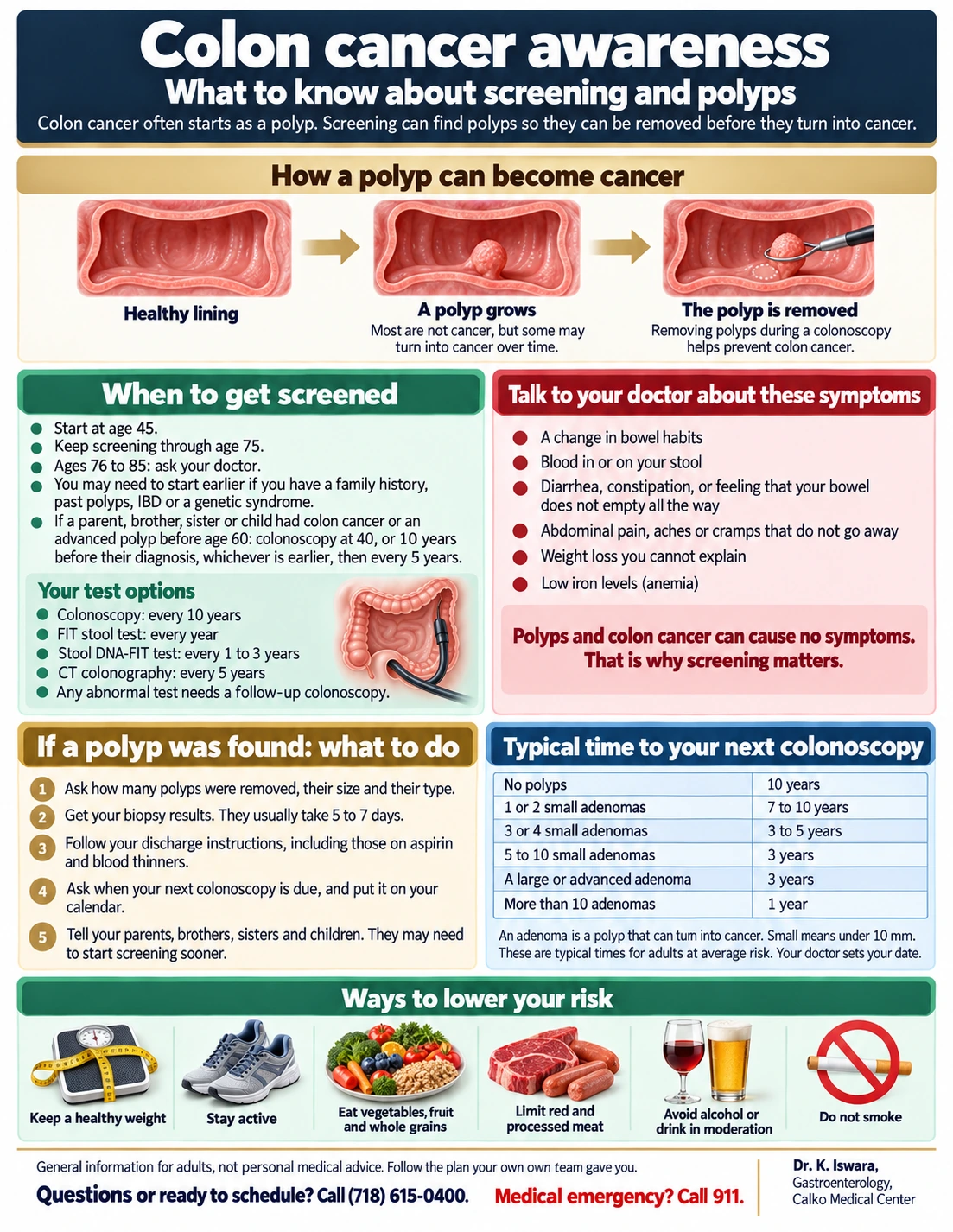
Colon cancer often starts as a polyp. Screening can find polyps so they can be removed before they turn into cancer.
How a polyp can become cancer
- Most polyps are not cancer, but some may turn into cancer over time.
- Removing polyps during a colonoscopy helps prevent colon cancer.
When to get screened
- Start at age 45.
- Keep screening through age 75.
- Ages 76 to 85: ask your doctor.
- You may need to start earlier if you have a family history, past polyps, IBD or a genetic syndrome.
- If a parent, brother, sister or child had colon cancer or an advanced polyp before age 60: colonoscopy at 40, or 10 years before their diagnosis, whichever is earlier, then every 5 years.
Your test options
- Colonoscopy: every 10 years
- FIT stool test: every year
- Stool DNA-FIT test: every 1 to 3 years
- CT colonography: every 5 years
- Any abnormal test needs a follow-up colonoscopy.
Talk to your doctor about these symptoms
- A change in bowel habits
- Blood in or on your stool
- Diarrhea, constipation, or feeling that your bowel does not empty all the way
- Abdominal pain, aches or cramps that do not go away
- Weight loss you cannot explain
- Low iron levels (anemia)
- Polyps and colon cancer can cause no symptoms. That is why screening matters.
If a polyp was found: what to do
- Ask how many polyps were removed, their size and their type.
- Get your biopsy results. They usually take 5 to 7 days.
- Follow your discharge instructions, including those on aspirin and blood thinners.
- Ask when your next colonoscopy is due, and put it on your calendar.
- Tell your parents, brothers, sisters and children. They may need to start screening sooner.
Typical time to your next colonoscopy
| No polyps | 10 years |
|---|---|
| 1 or 2 small adenomas | 7 to 10 years |
| 3 or 4 small adenomas | 3 to 5 years |
| 5 to 10 small adenomas | 3 years |
| A large or advanced adenoma | 3 years |
| More than 10 adenomas | 1 year |
An adenoma is a polyp that can turn into cancer. Small means under 10 mm. These are typical times for adults at average risk. Your doctor sets your date.
Ways to lower your risk
- Keep a healthy weight
- Stay active
- Eat vegetables, fruit and whole grains
- Limit red and processed meat
- Avoid alcohol or drink in moderation
- Do not smoke
General information for adults, not personal medical advice. Follow the plan your own care team gave you.
Questions or ready to schedule? Call (718) 615-0400. Medical emergency? Call 911.
Sources
- US Preventive Services Task Force, Colorectal cancer screening, 2021
- American Cancer Society, Screening recommendations
- US Multi-Society Task Force, Screening, 2017
- US Multi-Society Task Force, Follow-up after polyp removal, 2020
- Centers for Disease Control and Prevention, Symptoms
- National Institute of Diabetes and Digestive and Kidney Diseases, Colon polyps
- American Cancer Society, Prevention